What SAMR is...
SAMR is an acronym standing for Substitution, Augmentation, Modification, and Redefinition. This is referring to an educational model built for educators to use to combine pedagogy with technology. SAMR's format is presented in a hierarchical order beginning very basic from no document change, only becoming a digital version to progressively allowing the insert or embedding of additional media from simple enhancements to major transformations of a document or formatting a completely new document to integrate brand new design elements. SAMR is 14 years old created in 2010 by an educational researcher, Ruben Puentedura to share a common language across disciplines as teachers strive to personalize learning and and help students visualize complex concepts (PowerSchool, 2024).
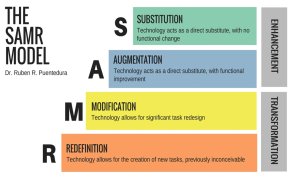
Creative CommonsThe SAMR model can help educators think about the role of technology in supporting learning.
"Substitution" means just that. In this case, the digital version is taking the place of the paper version. No changes are made to the original document except that the document is made available digitally.
"Augmentation" means to "add" something to an existing document like comments, hyperlinks, or multimedia. For example, making digital portfolios, instead of paper quizzes, implement gaming quizzes like Kahoot .
"Modification" is defined as adding a new way to manage the logistics of a classroom, like tracking grades, messaging students, creating a calendar, and posting assignments (Edutopia, 2024). Learning management systems examples that I am familiar with are Google Classroom and Canvas .
"Redefinition" means to implement activities that were not possible before and make it possible in the classroom, virtually. Examples include virtual field trips, author interviews after reading a class book, or learning around the world with other educators in any discipline.
What SAMR is Not...
The SAMR model in its current format is not sustainable per Jaclyn B. Stevens, Erasing the Lines: #SWIMLAPS, A Perspective On What's Broken With the SAMR Model, published 2015 or prior, (not directly indicated on web page). Stevens suggests to imagine the SAMR model as a swimming pool with substitution and augmentation in the shallow end and modification and redefinition in the deep end. The gamut of educators may choose to do cannonballs in the deep end, while some stay safe in the shallow end, and there may be some in the middle of the pool that may need special flotation supports represented by professional development, coaching, and professional learning networks (Stevens, no date indicated). The author is stating that SAMR is most student-centered when swimming from the shallow end to the deep end and educators that are technology reluctant may gradually grow toward the higher levels.
My Relationship with Technology...
Being brand new at the use of technology tools for document enhancements or inserting videos, hyperlinks, audio, or additional links, the SAMR framework tool appeared to be the easiest to envision the use of and to be the most productive for someone who is just getting introduced to the use of multimodal tools. I spend most of my time in the shallow end, probably between substitution and augmentation but I dabble with modification level as well for my children's school and my courses. Learning Managing Systems like Google Classroom and Canvas introduced during Covid and with managing Dominican courses, respectively, I did not personally set up the websites for use, however, after practice and trial and error, possibly watching you tube videos for LMS instruction, learning these frameworks can be self-taught. I think with time (no deadlines), patience, support, and practice I could reach the redefinition level. I have learned and are still learning, when it comes to technology, at some point, you just have to dive right in and go for it.
References
https://www.edutopia.org/article/powerful-model-understanding-good-tech-integration
http://www.jaclynbstevens.com/erasing-the-line--samr-model.html
https://www.powerschool.com/blog/samr-model-a-practical-guide-for-k-12-classroom-technology-integration/#:~:text=The%20letters%20%E2%80%9CSAMR%E2%80%9D%20stand%20for,help%20students%20visualize%20complex%20concepts
https://www.youtube.com/watch?v=V4FQ-j91waA
https://www.youtube.com/watch?v=rCNImsWUxZA
https://www.youtube.com/watch?v=xUo6urtbyLU


The nice part about SAMR is that you can change levels as you change tasks- you aren't at the same level all the time. To me, the swimming pool analogy releases folks from the guilt of thinking they aren't doing enough if they stay near substitution and augmentation.
ReplyDeleteThank you for this thorough breakdown of the SAMR model! While I had read a little about it before, I feel like this helps solidify it in my brain, especially with the swimming pool analogy (especially as somebody who likens anything possible to an analogy). When the flotation devices were mentioned, the first word to come to my mind was "scaffolds," because what are flotation devices if not a way to help us conquer the challenges of deeper water? Finally, telling us to dive right in at the end ties the whole post together (as I resist the urge to add a pun). Well done!
ReplyDelete